What Albemarle Would Cost Today
- Aston Wood
- 30 Jun, 2026
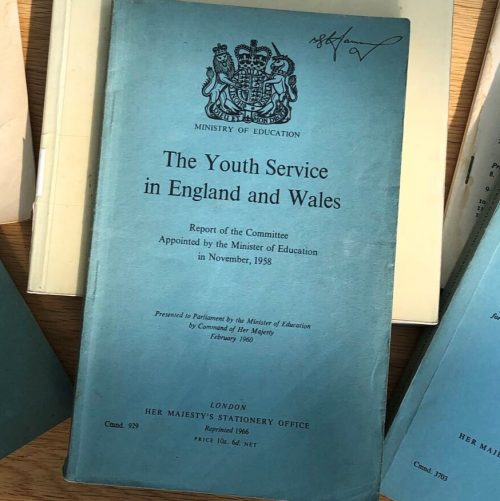
The Albemarle Report (1960) recommended a capital programme of £28 million for buildings, an increase to 1,300 full time Youth Workers, and a massive expansion of local authority youth provision. Adjusted for inflation and population growth, here is what that would cost today.
The scaling factors
Two adjustments are needed. Inflation and population.
The youth population aged 14 to 20 in 1960 was roughly 4.75 million. Today it is roughly 6.3 million[1]. That is a factor of 1.33.
The inflation multiplier from 1960 to 2026 is roughly 29.9. That means £1 in 1960 has the purchasing power of about £30 today[2].
Per young person
£1.11 billion is a big number. Divided across 6.3 million young people aged 14 to 20, it works out at roughly £176 per head. The Youth Investment Fund, the closest thing to a capital programme for youth spaces in recent years, works out at about £48 per head across the same age group. The gap is £128 per young person. That is less than a takeaway once a month. The entire shortfall in capital provision could be covered by an amount most people would not notice leaving their bank account.
The revenue gap is harder to calculate because there is no universal baseline to measure against. But if Albemarle’s implied revenue spending were adjusted the same way, the gap per young person would be larger still, because revenue has been cut harder than capital.
Full time staff
Albemarle wanted to increase full time leaders from 700 to 1,300.
Apply the population adjustment: 1,300 multiplied by 1.33 gives roughly 1,730. That is the minimum number of full time professional Youth Workers needed just to match the density of provision Albemarle recommended. And that is a baseline, because the 1960 model depended heavily on part time voluntary leaders who outnumbered paid staff by a wide margin. Rebuilding that volunteer infrastructure would require a workforce several times larger than this number suggests. The current workforce is not close[3].
To put 1,730 in perspective: that is one full time Youth Worker for every 3,640 young people in the age group. A secondary school of 1,200 pupils has one teacher for roughly every 20 students. The comparison is not fair, teaching and Youth Work are different things with different ratios. But the contrast tells you something about what kind of relationship each system is designed for. Teaching assumes proximity and compulsion. Youth Work assumes distance and choice. One worker for 3,640 young people can sustain contact with perhaps 60 to 100 of them in any meaningful way. The rest are the ones the service does not reach. It is a statement about how much access to Youth Work the state thinks young people deserve.
Buildings
Albemarle allocated £28 million for capital projects between 1960 and 1968.
Inflation takes £28 million to roughly £837 million. Population adjustment takes it to roughly £1.11 billion. That would fund approximately 4,000 youth centres, scaling the original 3,000 projects by the population factor.
For context, the recent Youth Investment Fund committed £300 million for roughly 276 centres. That is 27 per cent of the capital required to match Albemarle’s per capita provision. The remaining 73 per cent has not been promised by anyone.
Annual revenue
The Albemarle expansion was not just about buildings. It implied a massive increase in local authority spending on salaries, training, and operations. If capital values rose roughly 30 fold for inflation and the population grew 1.33 fold, the annual revenue budget required to sustain this service today would need to be roughly 40 times larger in nominal terms than the youth budgets of 1960. Local authority youth spending has gone in the opposite direction.
The table
| Metric | Albemarle target (1960) | Adjusted for today |
|---|---|---|
| Full time staff | 1,300 leaders | At least 1,730 |
| Capital investment | £28 million | £1.11 billion |
| Centres | 3,000 projects | Around 4,000 |
| Target age group | 4.75 million (14-20) | 6.3 million (14-20) |
What this means
The Youth Investment Fund covers about a quarter of the capital Albemarle’s vision would require at modern scale. The workforce gap is even wider. The annual revenue required to run a universal service at that level has no current political equivalent. Nobody is proposing it. Nobody is saying ‘we need to match Albemarle for today’. The ambition has been quietly dropped and replaced with a different question entirely: what is the cheapest way to make Youth Work useful to health, education and justice systems.
[1] ONS population data, mid 2024 estimates for 14–20 age band. Extrapolated to 2026.
[2] Bank of England inflation calculator. 1960 to 2026. RPI based.
[3] The 2023 NYA workforce survey estimated around 4,700 full time equivalent Youth Workers in England. But that includes everyone employed in the sector across all settings, not the universal service Albemarle was proposing. The comparison is not direct, but the direction is clear.